Béton
Brut

/ beh-TAWN broo / French · raw concrete

Photos of brutalist buildings from around the world. Some have Wikipedia pages. Some we have no idea where they are. Click any photo to enlarge.

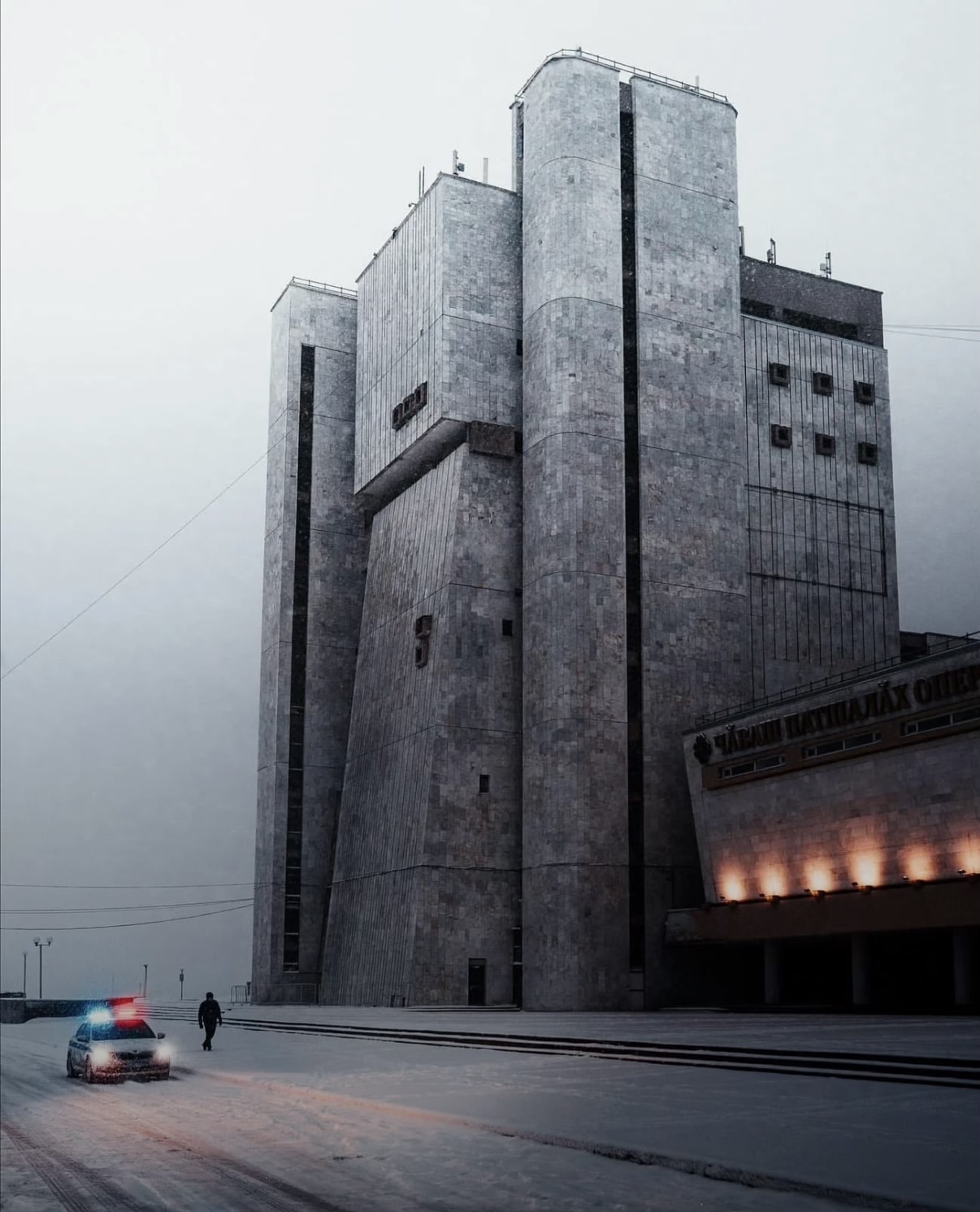
Chuvash State Opera and Ballet Theater — winter night, police car, lone figure dwarfed by concrete towers
Chuvash State Opera & Ballet Theater
Cheboksary, Russia · 1985 · R. Begunts & V. Teneta · Wikipedia ↗
Soviet high-rise housing blocks towering above street level, former USSR
Soviet High-Rise Blocks
Former USSR · Wikipedia ↗
Residential blocks in post-Soviet style, Vladivostok
Residential Blocks
Vladivostok, Russia
Soviet era apartment buildings in Minsk, Belarus
Soviet Era Apartments
Minsk, Belarus
Post-Soviet architecture apartment buildings in winter, Russia
Apartments in Winter
Russia · unknown city
Aerial view of Soviet era apartment buildings, former USSR
Soviet Blocks, Aerial
Unknown city, former USSR
Barbican Centre, London — brutalist concrete towers
Barbican Centre
London · 1969–1982 · Wikipedia ↗
Barbican Centre, London — lakeside view
Barbican — The Lakeside
London · 1982 · Wikipedia ↗
Alexandra Road Estate, London — brutalist housing in grayscale
Alexandra Road Estate
London · 1978 · Wikipedia ↗
Simon Fraser University, Burnaby — pond and concrete campus
Simon Fraser University
Burnaby, Canada · 1965 · Wikipedia ↗
Simon Fraser University, Burnaby — another building
Simon Fraser University
Burnaby, Canada · Arthur Erickson ↗
Brutalist interior staircase in Chandigarh, India — Le Corbusier Capitol Complex
Chandigarh Capitol Complex
India · Le Corbusier · Wikipedia ↗
Apartment buildings in the residential district of Dhaka, Bangladesh
Rajuk Uttara Apartments
Dhaka, Bangladesh
Modern brutalist building in Chur, Switzerland — angular concrete against clear sky
Brutalist Building
Chur, Switzerland
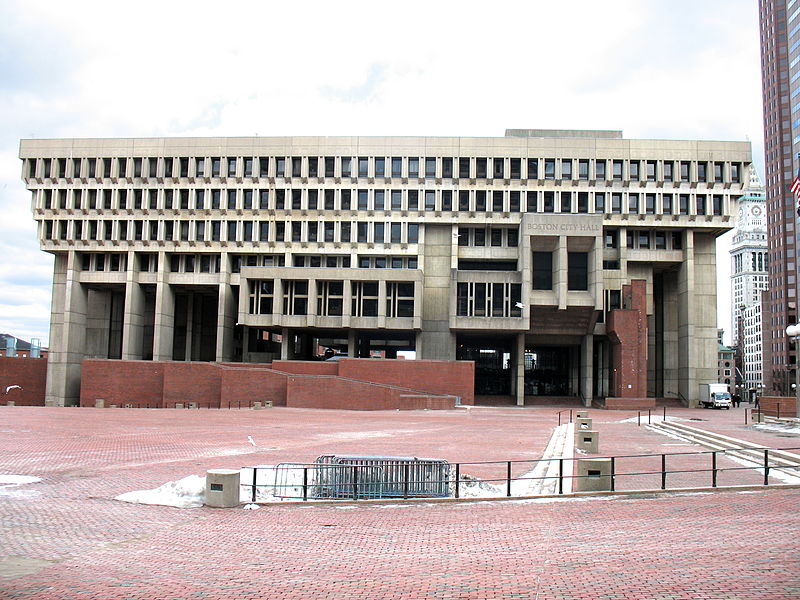
Boston City Hall — stepped concrete brutalist mass, Government Center
Boston City Hall
Boston · 1968 · voted most hated building in America. Also a city hall. · Wikipedia ↗
J. Edgar Hoover Building, FBI headquarters, Washington DC — concrete honeycomb facade
J. Edgar Hoover Building
Washington DC · 1975 · FBI headquarters · Wikipedia ↗
Geisel Library at UC San Diego — brutalist concrete structure rising from its base
Geisel Library
UC San Diego · 1970 · William Pereira · Wikipedia ↗
Yale Art and Architecture Building, New Haven — Paul Rudolph's corduroy concrete
Yale Art & Architecture Building
New Haven, CT · 1963 · Paul Rudolph · Wikipedia ↗
Robert C. Weaver Federal Building, HUD headquarters, Washington DC — Marcel Breuer brutalist
HUD Headquarters
Washington DC · 1968 · Marcel Breuer · Wikipedia ↗
Unknown brutalist housing block — black and white
Unknown Block
Location unknown
Brutalist concrete monument against sky
Concrete Monument
Probably Yugoslavia · probably 1970s
Brutalist building exterior, unknown location
Unknown Building
Location unknown
Abandoned brutalist building in urban park
Abandoned
Unknown city · unknown year
Brutalist concrete wall texture
Concrete Wall
No idea
Grayscale concrete wall
More Concrete
Also no idea
Brutalist architecture, black and white, unknown building
Unknown Building
Location unknown
Dramatic brutalist architecture, black and white, unknown building
Unknown Building
Location unknown
Industrial brutalist architecture, unknown location
Industrial Brutalist
Location unknown
Corner of a brutalist building, unknown location
Corner
Location unknown
Exterior of old concrete building, unknown location
Shabby Concrete
Location unknown

What was it?

Le Corbusier described his Unité d'Habitation in Marseille in 1953 as béton brut — raw concrete. He meant it literally: strip the formwork, leave whatever the concrete looks like, don't plaster it or paint it or apologize for it.

Architects in London, Boston, New Haven, Belgrade, Montreal, Chandigarh, and Tokyo ran with it. By the 1960s they were building housing estates, universities, civic centres, and memorials entirely out of exposed concrete. Le Corbusier planned entire cities in India with it. The Soviet Union built vast quantities of it, mostly housing. Post-colonial governments across Asia and Africa used it to signal modernity. In America, Paul Rudolph and Marcel Breuer gave it to government agencies and universities. Some of it is extraordinary. Some of it is grim. Most of it is both.

Most of it got built between 1953 and the late 1970s. Then it became unpopular. Then a lot of it got demolished. Then people started trying to save what was left. Boston City Hall was just designated a historic landmark in 2024. The FBI is moving out of the Hoover Building and nobody agrees what to do with it.